Perinatal Mental Health for Working Mothers: What's Normal, What's Not
Perinatal mental health covers the emotional and psychological wellbeing of a woman from pregnancy through the first year postpartum, including the transition back to work. It's broader than postpartum depression alone and includes postpartum anxiety, intrusive thoughts, and the specific stress of resuming a job while still adjusting to a body, a schedule, and an identity that don't feel entirely like your own yet.
I'm a Perinatal Mental Health Certified (PMH-C) clinician, which means I've done specific advanced training in this exact period of a woman's life, on top of my general license. Most working-mom content doesn't come from someone with that training, which is part of why the return-to-work transition specifically gets so little real attention.
The return to work transition, specifically
Much of the writing about postpartum life focuses on the first weeks after birth. Far less addresses what happens when leave ends and a woman is expected to function at full capacity at work while still deep in a physical and emotional recovery that doesn't follow a calendar.
The numbers here are more stark than most people realize. The Policy Center for Maternal Mental Health reports that 1 in 4 U.S. mothers return to work within ten days of giving birth, and research has found that maternity leaves of twelve weeks or shorter are associated with higher rates of postpartum depression, with each additional week under that twelve-week mark linked to lower odds of it. If you went back to work sooner than felt right and you're still feeling the effects of that, you're not imagining it.
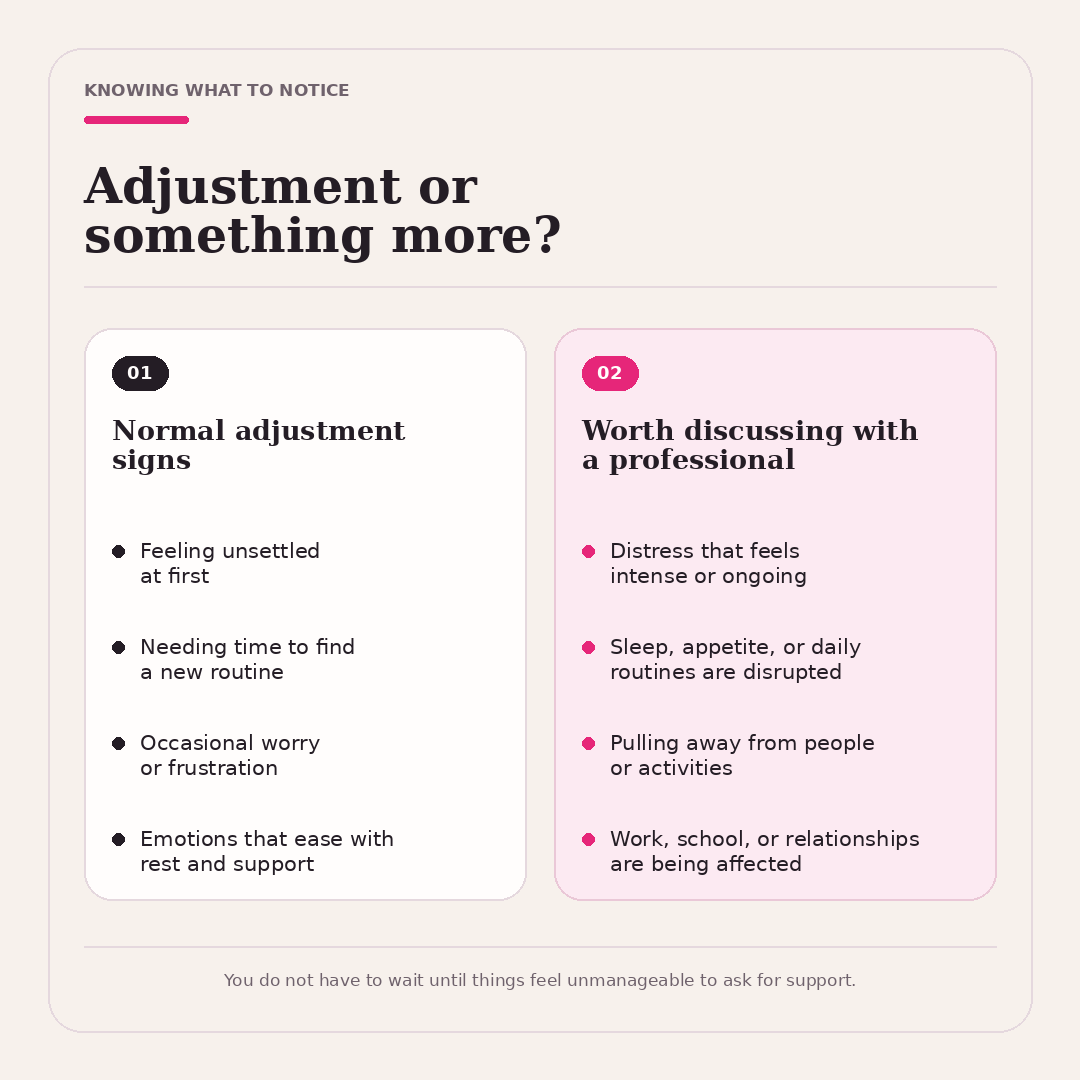
What's a normal hard adjustment, and what deserves real support
Some amount of difficulty here is expected. Feeling foggy, tearing up more easily, missing your baby during the workday, feeling like you're doing both jobs poorly for a while, all of that is a normal part of an enormous transition, and it tends to ease as your body recovers and a new rhythm sets in.
Here's where the line typically sits:
Normal adjustment: occasional low mood, tearfulness, worry about your baby that eases when you check in on them, exhaustion that improves with rest and time.
Worth a conversation: persistent anxiety that doesn't lift, dread that follows you through the day, intrusive thoughts that scare you, a sense of disconnection from your baby or your work that isn't improving after a few weeks, or feeling like you're just going through the motions with nothing underneath.
About one in five U.S. mothers report postpartum depressive symptoms, so if this describes you, you are far from alone, and it is treatable.
Why this level of content is missing elsewhere
Most working-mom content is written from lived experience alone, which is valuable, but it isn't the same as clinical training in this specific period. The return-to-work transition sits right at the intersection of workplace leadership content and maternal mental health content, and most writers only cover one side of that intersection. “Read the leadership skills pillar for the workplace side of this transition”
The burnout that shows up later in a working mother's career often traces back to a return-to-work period that never got real support the first time around. “See how an unsupported return to work feeds burnout later”
A next step, without pressure
If what you're feeling sounds like more than a normal hard adjustment, the most useful next step is talking to a perinatal mental health professional, not pushing through alone or waiting to see if it passes. If guilt about needing support at all is part of what's holding you back, that's exactly what the Working Mom Guilt Breakthrough guide addresses. “Get the Working Mom Guilt Breakthrough guide”
Frequently Asked Questions:
-
Perinatal mental health covers emotional and psychological wellbeing from pregnancy through the first year postpartum, including the return to work, and includes postpartum depression, postpartum anxiety, and intrusive thoughts, not just one condition.
-
Some difficulty is expected and often eases with time, including fogginess, tearfulness, and exhaustion. Persistent anxiety, dread that doesn't lift, or intrusive thoughts that scare you are signs it may be more than a normal adjustment and worth discussing with a professional.
-
About 1 in 5 U.S. mothers report postpartum depressive symptoms, according to research cited by the Policy Center for Maternal Mental Health. It is common and treatable, not a personal failure.
-
Research has found that maternity leaves of twelve weeks or shorter are associated with higher rates of postpartum depression, and 1 in 4 U.S. mothers return to work within just ten days of giving birth, according to the Policy Center for Maternal Mental Health.