Leadership Skills for Working Mothers No One Taught Her
Leadership skills for working mothers are the specific abilities, setting boundaries, delegating without guilt, communicating needs directly, and making decisions with confidence, that let a woman lead at work while also running a household, without burning out trying to do both perfectly. Most leadership training never accounts for the second full time job waiting at home, which is why so many capable women still feel unprepared to lead.
I'm a Licensed Professional Counselor Supervisor with over a decade of clinical supervision experience, and nearly every working mother I coach has the same realization at some point. She's good at her job. She's good at parenting. And no one ever actually taught her how to do both at once without giving something away, usually herself.
Why leadership training rarely accounts for the working-mom reality
Most leadership development was built around a version of a leader who has someone else handling the household. Delegate more, say no more, protect your calendar, the advice sounds simple until you're the one also packing lunches and remembering the permission slip.
This isn't just a feeling. Gallup research conducted with the State of Idaho found women are three times more likely than men to be the default responder to unexpected child care issues, 66 percent compared to 22 percent, and that 79 percent of working mothers who want more help don't feel comfortable asking for it. That's not a confidence problem. That's a system that never built room for the reality working mothers are actually operating in.
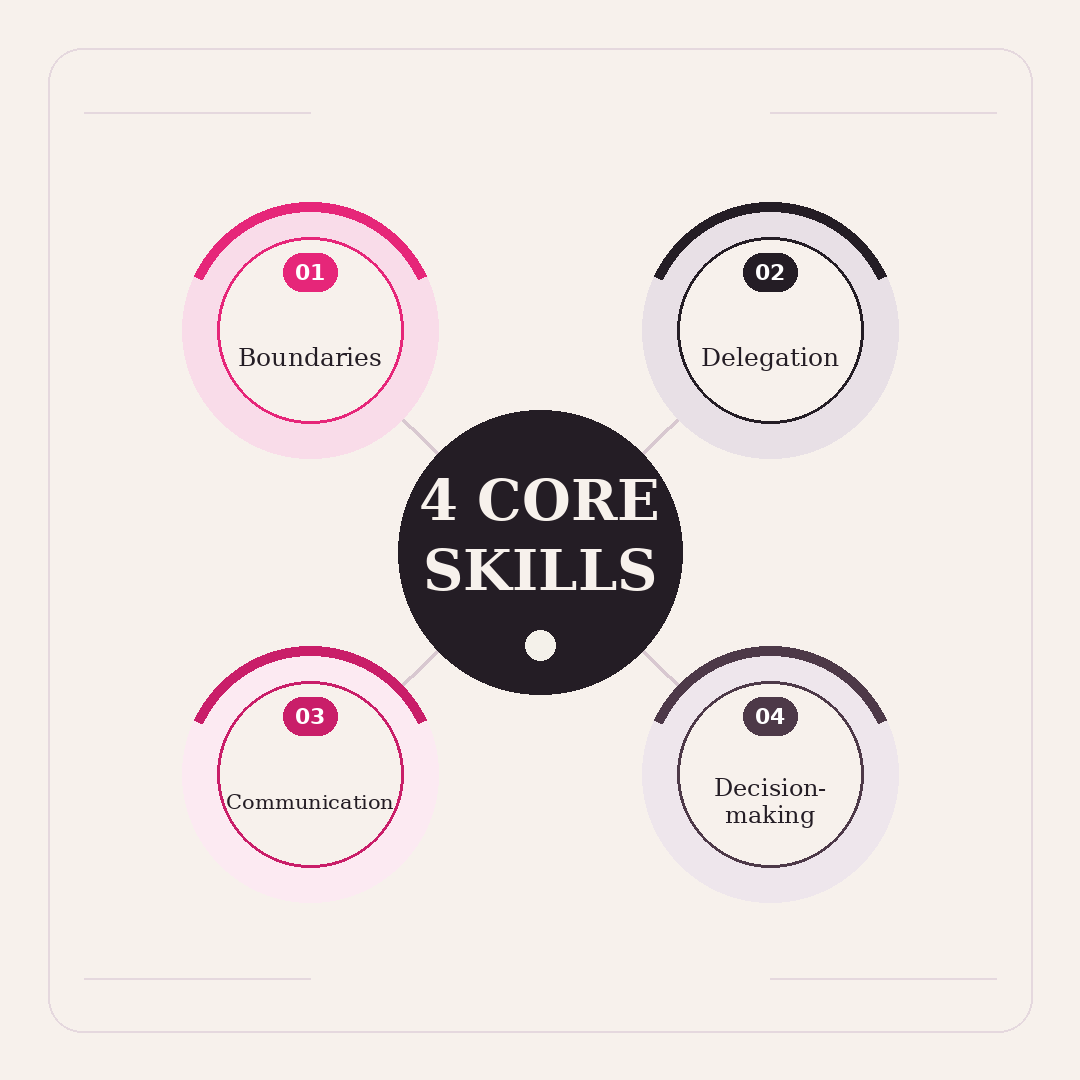
The 4 skills that matter most
Boundaries. Knowing what you will and won't take on, and saying so without over-explaining or apologizing first.
Delegation. Handing off work, at home and at the office, without treating it as a personal failure.
Direct communication. Saying what you need in plain language instead of hoping someone notices.
Decision-making under fatigue. Making calls quickly and moving on, instead of replaying every choice afterward.
These aren't personality traits some women have and others don't. They're skills, which means they can be practiced and built, the same way you'd build any other capability at work.
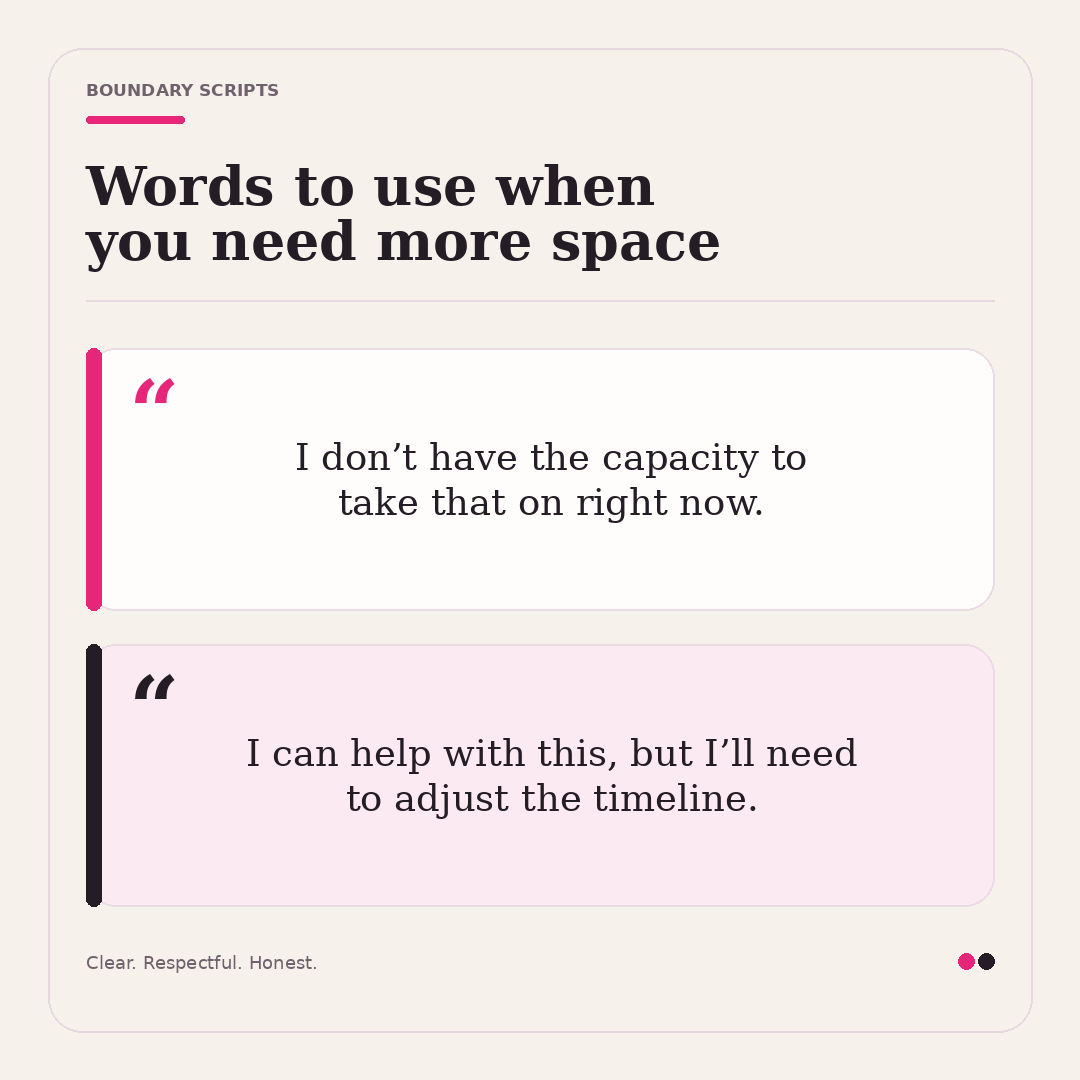
What a boundary actually sounds like
Boundaries fail most often not because the idea is wrong, but because the words never get practiced in advance. A few that work without sounding harsh:
"I can take this on, but something else will need to move. Which would you rather I deprioritize?"
"I'm not able to get to this today. I can have it to you by Thursday."
"I need to step away at 5:30 for a family commitment. I'll pick this back up first thing tomorrow."
Notice none of these include an apology or a lengthy justification. A boundary that needs a paragraph of explanation usually isn't a boundary yet, it's a negotiation. “See how unspoken boundaries feed burnout in the burnout pillar”
Confidence as a practiced skill, not a personality trait
Confidence at work often gets treated like something you either have or don't. In practice, it's closer to a muscle. The women who sound confident in meetings aren't necessarily the ones who feel the most certain, they're the ones who've said the hard thing out loud enough times that it no longer feels like a risk.
That repetition is also most of what coaching actually does. It's a practice space for saying the boundary, making the ask, or pushing back on a decision before you have to do it live, with real stakes attached. “Read more on building ambition without guilt in the Boldly Both pillar”
Where to start
If boundaries, delegation, or speaking up at work feel like the hardest part of this, that's common, and it's learnable. “Get the Working Mom Guilt Breakthrough guide”
Frequently Asked Questions:
-
The four that matter most are setting boundaries, delegating without guilt, communicating needs directly, and making decisions confidently under fatigue. These are learnable skills, not fixed traits, and most leadership training never addresses them in the context of also running a household.
-
State what you can and can't take on plainly, offer an alternative when possible, and skip the lengthy apology or justification. A boundary that needs a paragraph of explanation is usually a negotiation instead. For example: "I'm not able to get to this today, I can have it to you by Thursday."
-
Many working mothers treat delegating as a personal failure rather than a leadership skill, both at work and at home. Reframing it as a skill to build, rather than a sign of not handling things, is usually the first shift that makes it easier to actually do.
-
No. Confidence functions more like a practiced skill than a fixed trait. Saying the hard thing out loud repeatedly, ideally in a lower-stakes setting first, is what tends to build it, not waiting to feel ready.